Upcoming Events

A puppet can be made out of anything! Even at lunch, you could pick up a napkin and a fork to tell a story that gets the kids—and even grandma—laughing.
Puppets can also be made of highly advanced, synthesized materials developed just for a character, helping to create some of the most compelling, lifelike creatures imaginable(Yoda being an early example). Those kinds of puppets can be very expensive and often take years to learn how to properly design and animate.
Here at Stepping Stones, we love to use materials you might find around the house.
Our favorite material is cardboard.
Cardboard is one of the most readily available and versatile materials you can find. It can be shaped, folded, cut, reassembled, painted—whatever! You could take a square of it, draw a face, put it on a stick, and call it a day, or spend days constructing an elaborate sculpture that’s good enough for a debut at an art gallery. We LOVE it.
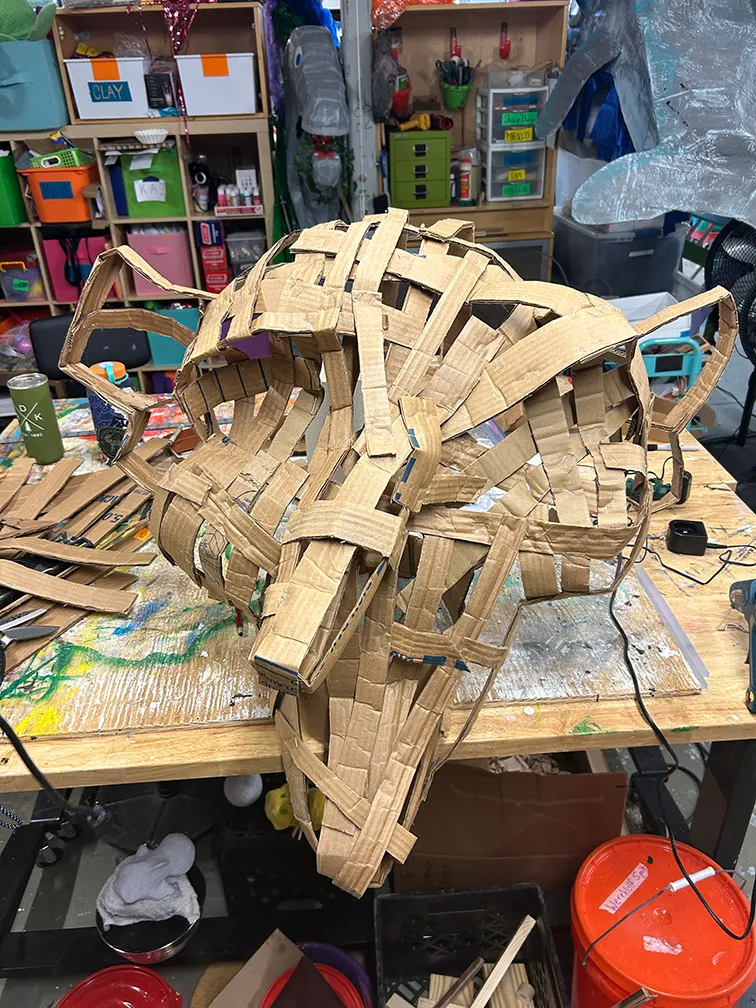
In most of our puppets, cardboard is involved. We’ve used cardboard to create figures small enough to fit on a child’s hand, as well as 15-foot-tall giants like our Mother Nature puppet or our giant giraffe. For our largest puppets, our head puppeteer, TJ, uses long strips of cardboard that he weaves together and fixes in place with staples and hot glue.
Once the desired shape is sculpted, team members, volunteers, or children cover the structure in papier-mâché—pieces of paper dipped in glue and layered on in overlapping patterns.
Through this process, children engage in problem-solving, spatial reasoning, collaboration, and patience, all while bringing an idea to life.
We’ve even used cardboard dust from our Chomp Saws to create “cardboard clay”—a mixture of the dust, our own glue (called “werewolf spit”), and plenty of elbow grease. This cardboard clay becomes a thick paste that we’ve used to create the heads of our jazz band characters (The Stepping Stones), giving them a durable, highly textured, and touchable finish. These experiments invite curiosity, material science exploration, and hands-on engineering in a way that feels playful and approachable.
Whether we’re using cardboard, wood, or thrown-out toys, we aim to create puppets that children can directly interact with–
Puppets that feel personable, safe, and inviting to touch. If we’re making a dog, we want to be sure it has snuggly fur that you want to hug. This often leads our puppets to take on a cartoony quality, so even our spookier characters might feel like a friend you meet at Stepping Stones.
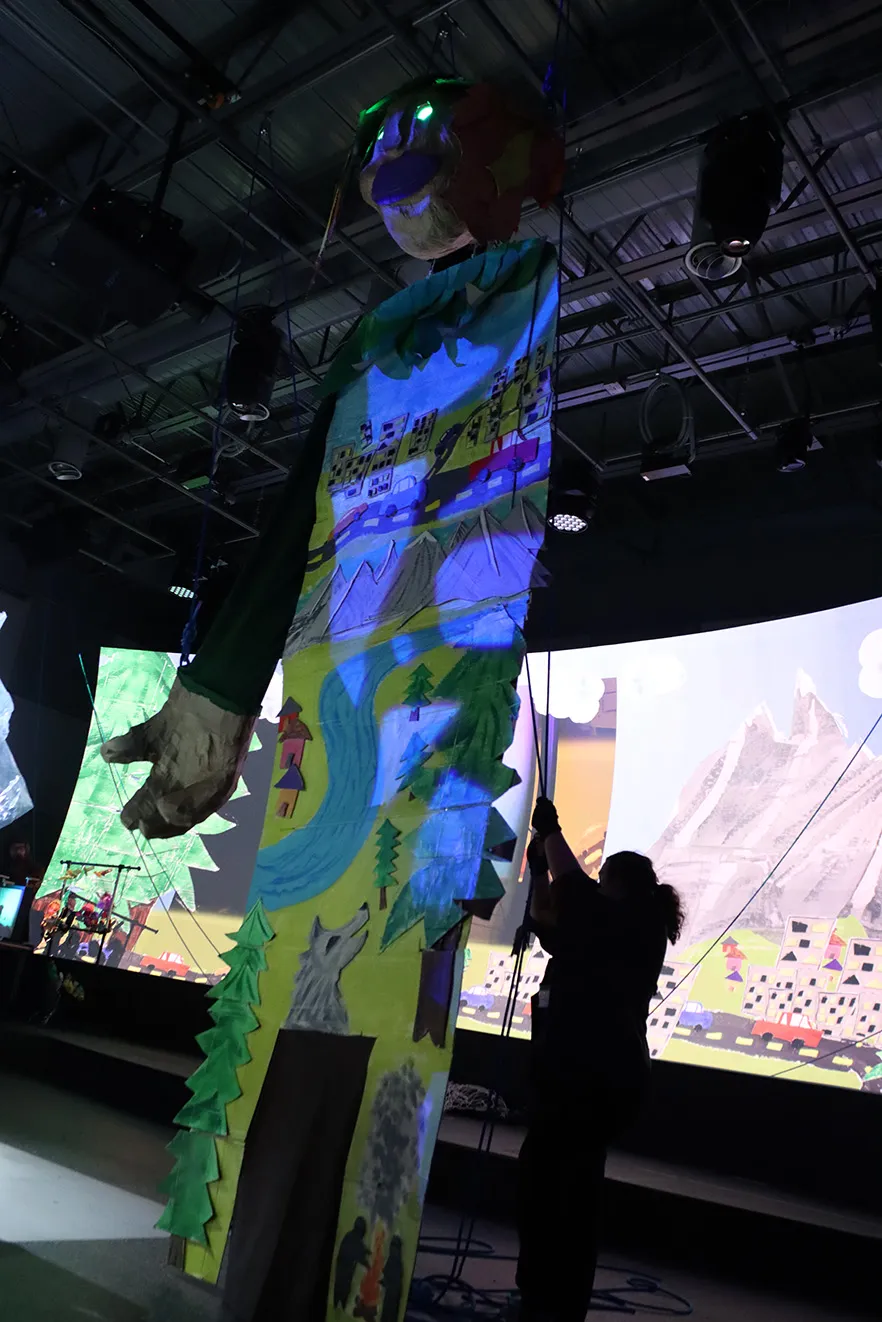
Another quality we strive for is creating figures that look and feel distinctly handcrafted(because they are). We may intentionally leave parts unfinished or a little rough around the edges. This is done to emphasize the accessibility and honesty of the art form—so when a child or caregiver looks at a puppet, it’s clear that with an idea, time, and care, they could make one too. In this way, puppetry becomes a mindful, responsible, and empathetic practice—one that values creativity, reuse, and the belief that making something by hand can help us better understand ourselves and one another.