





Upcoming Shows

Upcoming Events
Think of a puppet show. What images or sounds arise? Some may imagine a humble frog or an exquisitely dressed pig. Others picture eerie marionettes on strings.
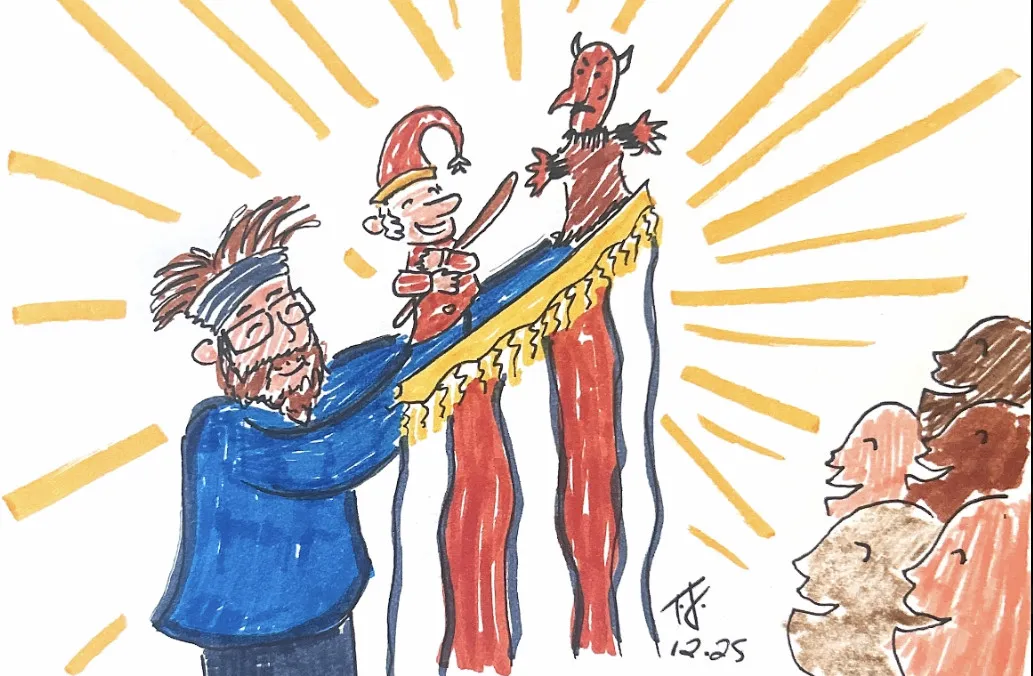
For over 360 years, many would have imagined something quite different: the lively energy of Mister Punch – a flash of bright red fabric, a reedy voice and explosive comic action.
For centuries, trickster puppets like Mister Punch have invited audiences into playful disruption. Today, these characters offer something especially valuable in museum education: experiential learning through laughter, participation and discovery.
A Tradition of Playful Disruption
For hundreds of years, the trickster puppet thrived in marketplaces, fairgrounds, street corners and community halls. The tale of Mister Punch and his wife Judy has been performed countless times, each performance shaped by audience interaction.
A traditional Punch and Judy show follows a simple pattern:
• Mister Punch is given a task.
• He resists or mismanages it.
• Authority figures attempt to restore order.
• Punch escapes consequences.
Punch resists rules, hierarchy and expectation, embodying playful rebellion through exaggerated conflict and comic confrontation. Even when defeated – perhaps swallowed by a crocodile or outwitted by another character – he returns unharmed at the next performance. His setbacks are only temporary interruptions in an ongoing cycle.
This figure appears across cultures under different names: Pulcinella in Italy, Kasperle in Germany, Petrushka in Russia and many others. Though their stories differ, they share a common spirit –curiosity, disruption and resilience.

The Trickster and Renewal
In Russia, Petrushka’s name derives from“parsley,” symbolically linking the character to growth and renewal. Puppeteers sometimes describe themselves as “parsley farmers,” cultivating the character’s continual rebirth.
A master of the form, Vsevolod Mizenin, describes the performance cycle as:
“The theory of the grain: in order to be reborn, one must die.”
In performances for children, this idea becomes an exploration of persistence and growth. The trickster encounters challenges and adapts again and again, modeling resilience and creative problem-solving through play.
Welcoming the Trickster at Stepping Stones
At Stepping Stones Museum for Children, we welcome the trickster as a powerful tool for experiential learning.
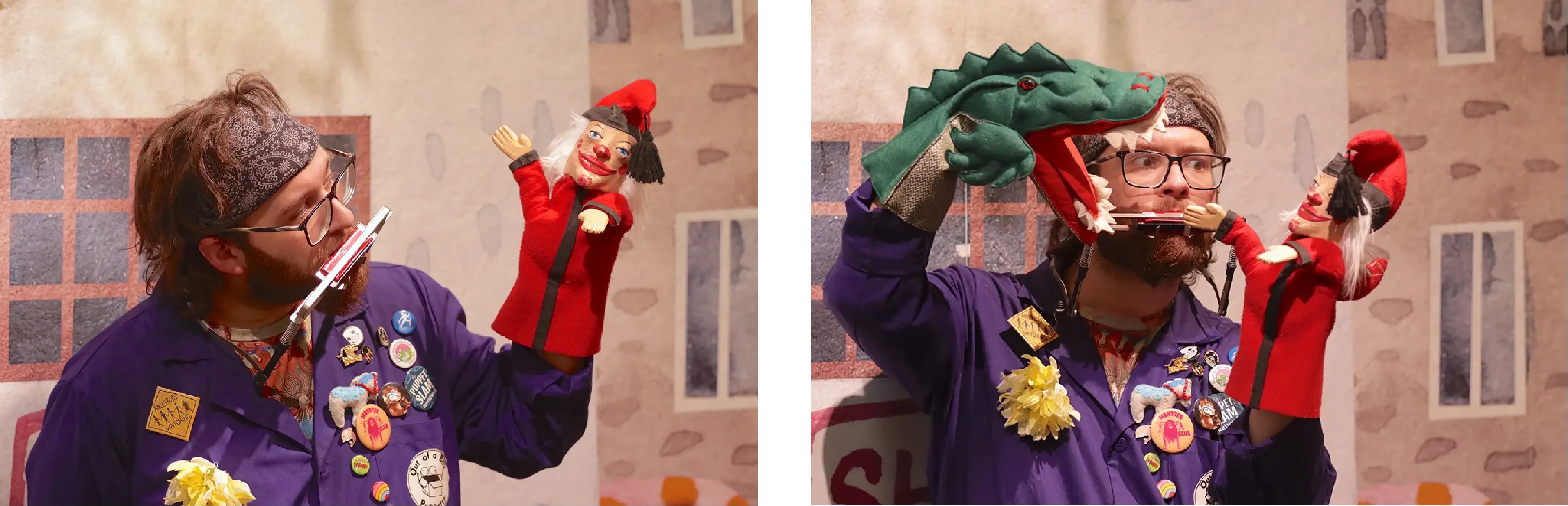
During a puppet festival in Vermont, I acquired an antique Mister Punch – dressed in bright red with a curled hat and an impish grin. Equal parts delightful and unsettling, he seemed ready for mischief. I paired him with a vintage German dragon hand puppet and brought them into the Museum.
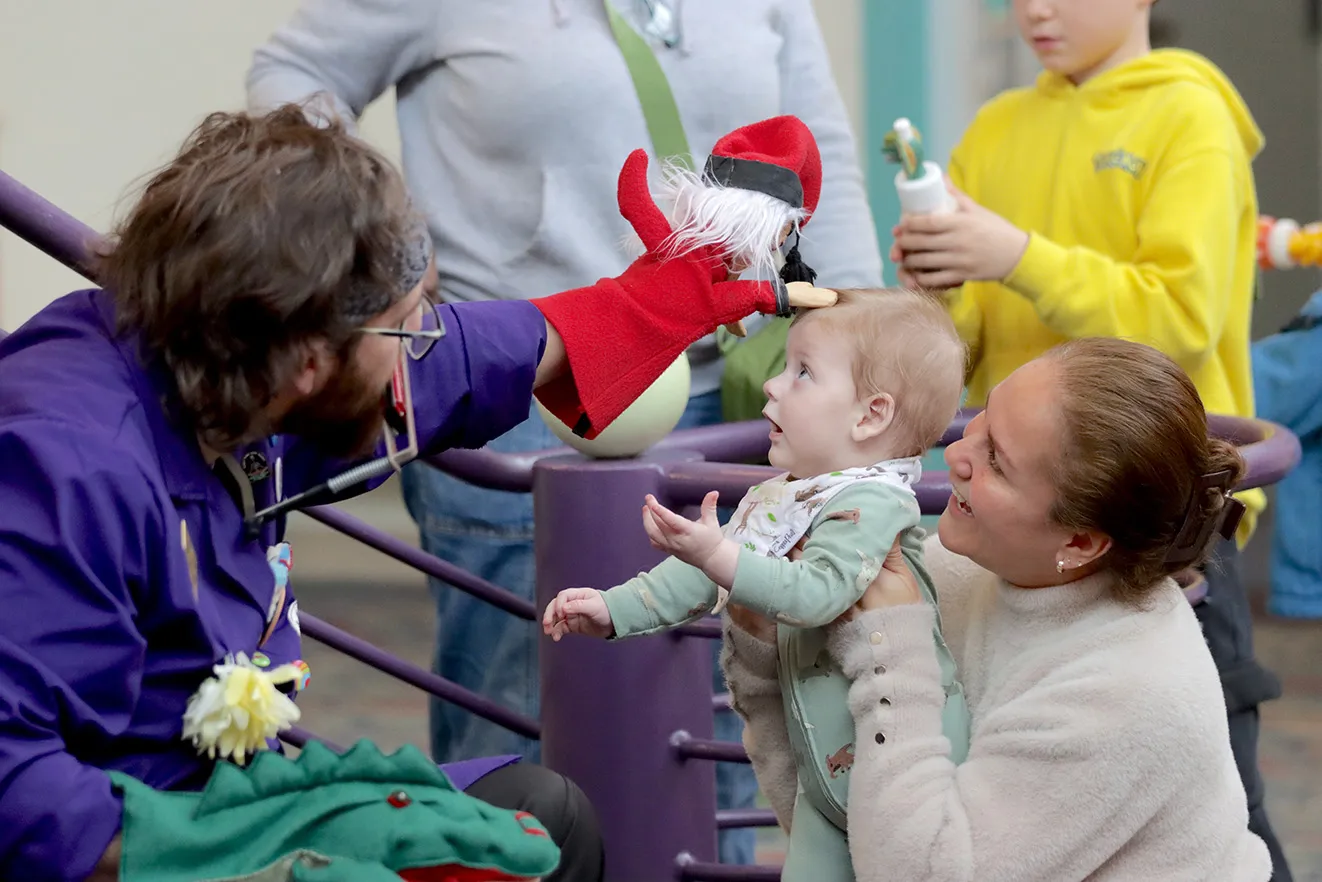
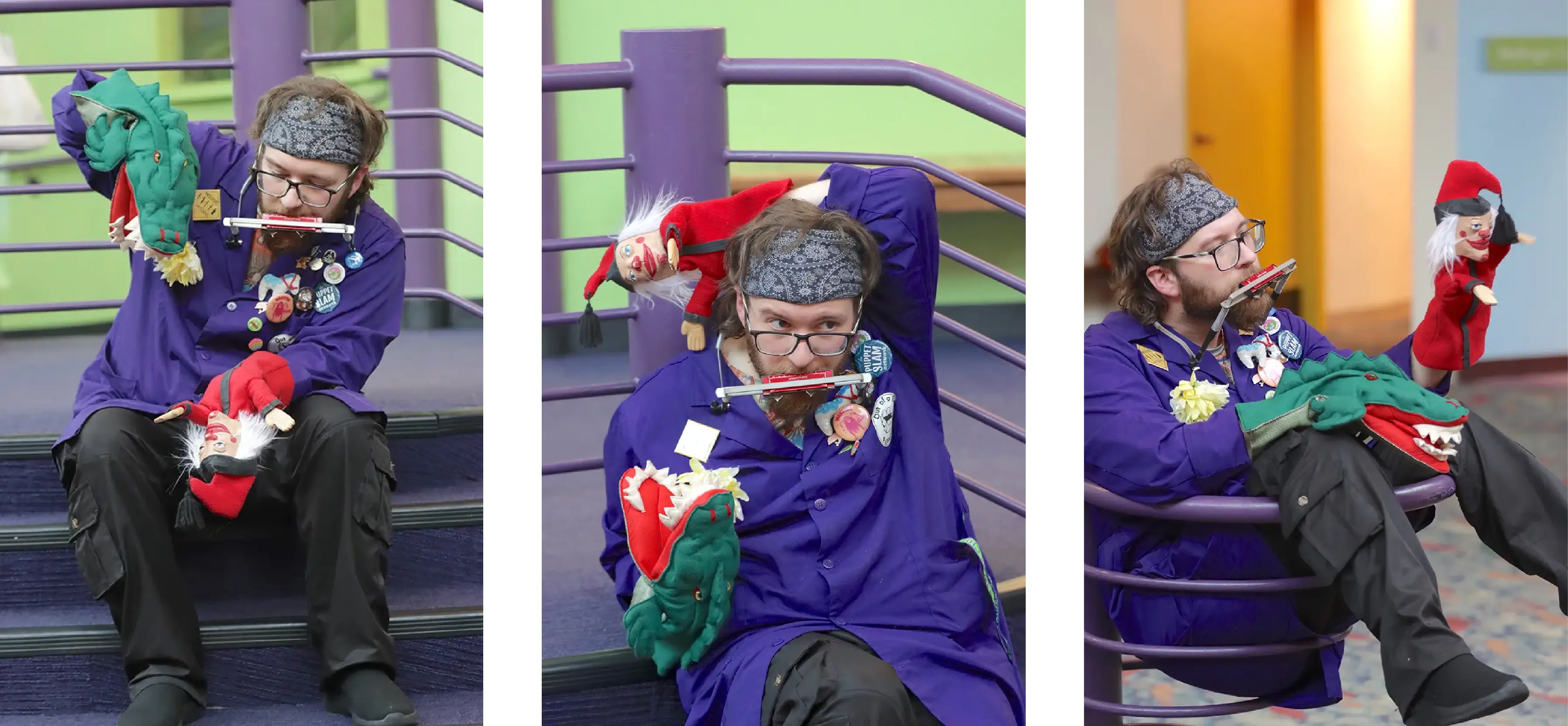
There is no puppet booth to contain their antics. Instead, I roam the Museum exhibitions wearing both puppets, often hiding the Dragon and using a harmonica to voice Punch.
What follows is a series of lively encounters. Punch may dance, get chased by the Dragon or be playfully “eaten”and reappear moments later. At the Grocery Store exhibit, the Dragon might steal items from Punch’s cart whenever he turns his back. At the block station, the Dragon may disrupt Punch’s careful construction.
Children quickly become participants. They take sides, offer help, create new rules and invent their own games. They may feed the Dragon, assist Punch or attempt to negotiate peace – though neither character is entirely trustworthy.
These encounters invite children into storytelling, encourage spontaneous cooperation and create shared moments of discovery. Our goal is not only to entertain, but to build confidence, connection and curiosity through meaningful experiences.
Why Children Respond to the Trickster
Across cultures, the trickster archetype embodies curiosity and discovery. As Mizenin explains:
“He reminds us of a time when we didn’t overthink, when we acted.”
This reflects how children naturally learn – through movement, exploration and direct experience.
Trickster puppetry supports:
• Social-emotional development – children navigate surprise, tension and resolution in a safe environment.
• Creative confidence – unpredictable interactions encourage imaginative thinking.
• Active participation – visitors become collaborators in the performance.
• Resilience and adaptability – challenges become opportunities for growth.
These outcomes align closely with Stepping Stones’ commitment to whole-child development and learning through play.

Laughter as Understanding
Cultural theorist Mikhail Bakhtin wrote:
“Laughter is not the opposite of seriousness – it is another form of truth.”
Within museum education, laughter increases engagement, builds emotional safety, strengthens connection, and supports attention and memory. Through humor, children explore complex ideas inaccessible and meaningful ways.
Why This Tradition Matters Today
Trickster puppetry offers something increasingly rare: unscripted interaction, shared laughter, and collaborative meaning-making. It encourages children to engage with complexity, adapt to change and approach the world with curiosity.
For the trickster to remain vital, Mizenin explains, performers must:
“Engage fully with the audience. Stop thinking and start acting.”
This spirit of authentic presence and responsiveness lies at the heart of experiential museum education.
The Future of Playful Learning
Mister Punch, Petrushka, and their global counterparts endure because they reveal something essential: children learn most deeply through direct experience.
Through playful disruption, creative risk and shared laughter, the art of the trickster supports the development of confident, curious learners who engage fully with the world around them.
When a puppet runs through a crowd and children follow with laughter and wonder, learning is not delivered – it is discovered.
As Punch has proclaimed for centuries:
“That’s the way to do it.”