





Upcoming Shows

Upcoming Events
Red. Blue. Yellow.
Circles. Squares. Triangles.
All the tones between. All the linesbetween.
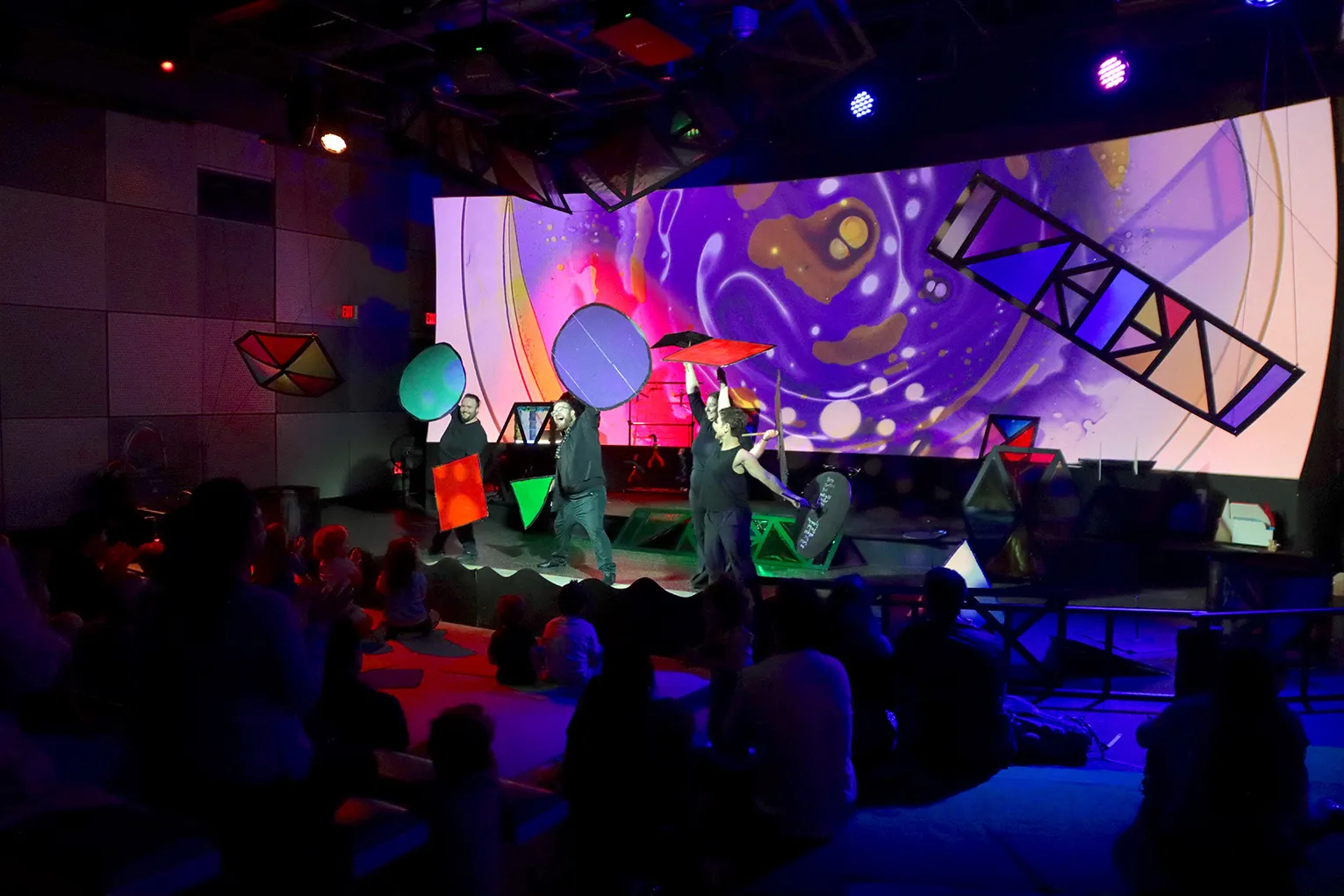
Jazz. Play. Art in motion.
Look around.
A door. A chair. A body in space.
But closer,
A rectangle. A plane. A texture. A weight.
A feeling.
Everything we encounter is more than what we call it.
Every object is a composition.
Every surface, a possibility.
This is the first stroke on the canvas.
Seeing Beyond Symbols
In puppetry, we practice a kind of gentle undoing.
A water bottle is not just a water bottle.
It is a curve. A transparency. A rhythm waiting to be found.
Move it, and it becomes a fish.
Crush it, and it becomes a landscape.
Suspend it, and it becomes something that has never existed before,
while never exceeding the confines of itself.
This is not about illusion.
It is about relationship.
To material.
To motion.
To perception itself.
Through our work with Out of a Box Puppetry, we invite children into this space—not as spectators, but as co-discoverers.
We are not asking, What is it?
We are asking, What else could it be?
The Discipline of Simplicity
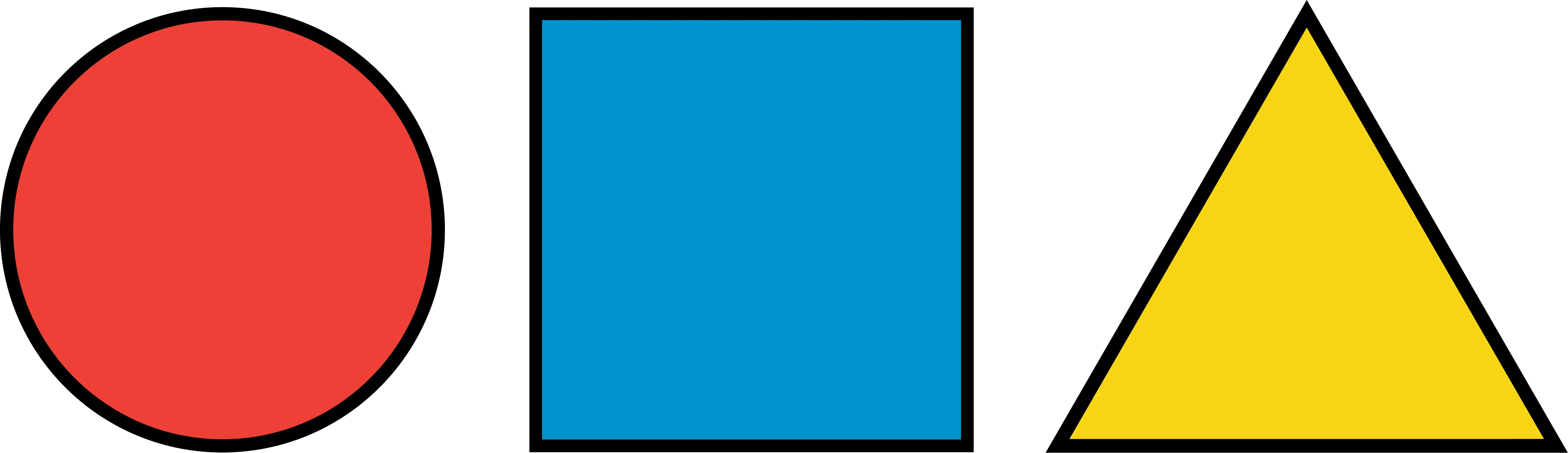
Start with a circle.
A triangle.
A square.
Limit the palette.
Open the world.
From these shapes, something begins to emerge,
not fixed characters, but presences.
Not stories told, but stories forming.
A circle can be a face, or a sun, or a pulse.
A triangle can be sharp, or quick, or mischievous.
A square can anchor, hold, resist.
Meaning is not assigned.
It is felt.
What Is Puppetry, If Not This?
Shapes & Colors asks a question:
What remains when we strip puppetry down to its core?
Remove the script.
Remove the character.
Remove the need to explain.
What is left?
Color.
Form.
Movement.
Time.
Puppetry becomes not a representation of life, but an enactment of it.
Objects breathe.
Shapes listen.
Space responds.
Moving to the Music
The stage does not sit still.
It swings.
It fractures.
It opens.
Guided by jazz, the entire environment becomes responsive. Rhythm is not accompaniment; it is gravity.
Objects fall into time.
Then slip out of it.
Then return, changed.
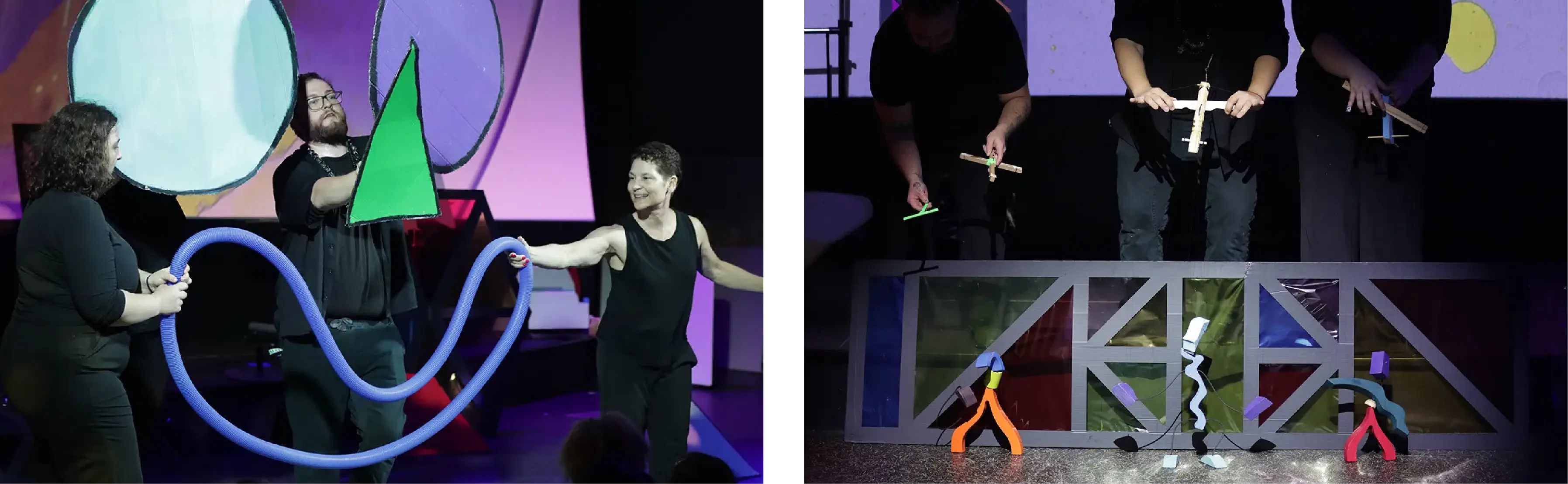
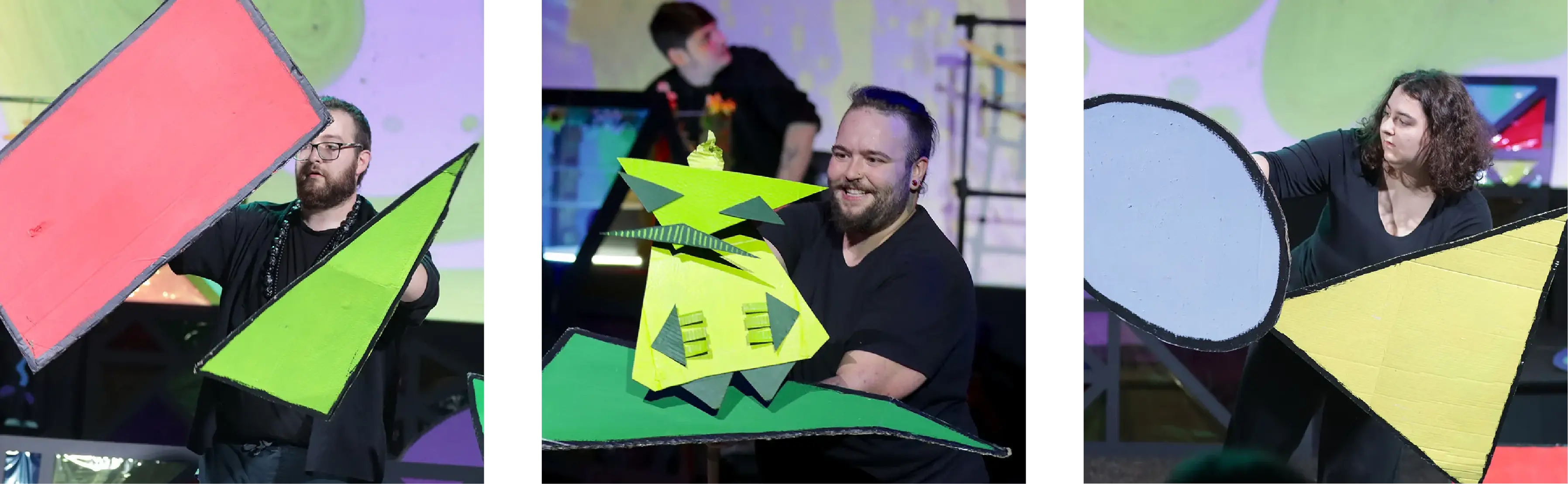
Large flat shapes glide through space like fragments of a living painting.
Abstract marionettes, lines, angles, color-fields, encounter one another, separate, reconnect.
They do not “act.”
They relate.
A World You Can Enter
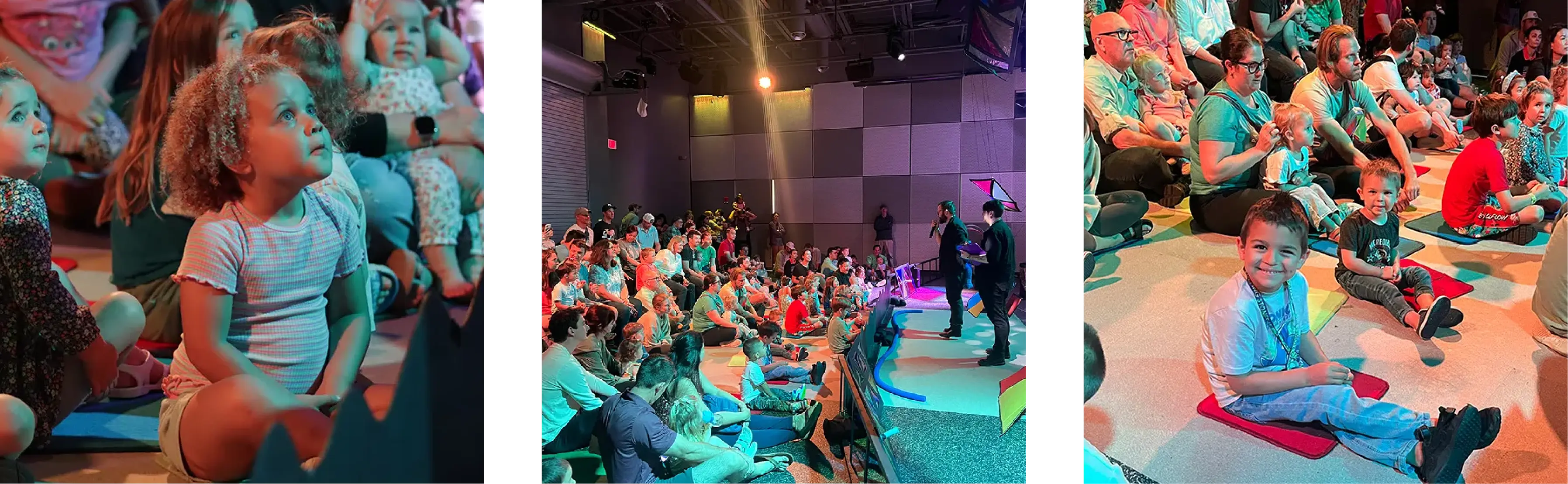
The boundary between stage and audience softens.
Bright orange tubes are placed into children’s hands, across their shoulders, around their bodies, extensions of the visual field.
Giant balloons drift and collide, slow and buoyant, turning the air itself into material.
Overhead, large-scale forms hover: kaleidoscopic, shifting, almost architectural.
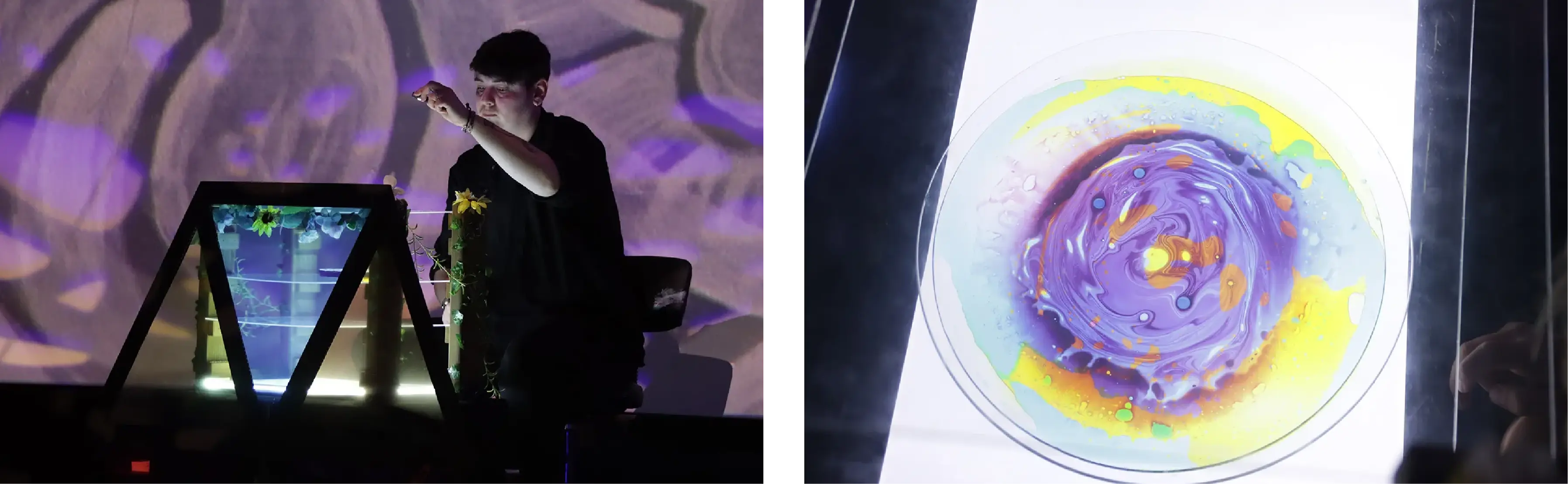
Behind them, liquid light spills and transforms, creating an ever-changing horizon of color and motion.
The space is not watched.
It is inhabited.
Seeing With More Than Eyes
Something subtle begins to happen.
Color is no longer just seen, it is felt.
Sound is no longer just heard, it is spatial.
Movement is no longer just observed, it is shared.
A yellow shape hums with energy.
A deep blue slows the room.
A sudden angle of red cuts through attention.
Children understand this immediately.
Not intellectually,
but physically.
Intuitively.
Three Ways of Being There
There is no single right way to enter.
Some children watch.
Still. Absorbing. Letting the rhythm settle their bodies.
Some children track the mechanics,
the strings, the hands, the systems,
seeing how the world is built.
Some step inside,
moving, dancing, becoming part of the composition.
All of these are forms of participation.
All of these are complete.
Why This Work Exists
Because the world can harden too quickly into definitions.
This is a door.
This is a triangle.
This is how it is used.
But before that,
there is openness.
Shapes & Colors lives in that openness.
It invites children to meet structure with curiosity.
To meet form with imagination.
To meet the familiar with fresh perception.
This is not just art-making.
It is a practice of attention.
An Invitation to Stay Awake
Everything is already here.
A line.
A curve.
A surface.
A sound.
Nothing needs to be added.
When a child discovers that a simple shape can move, feel, and transform, something shifts.
The world becomes less fixed.
More alive.
More available.
And in that shift, learning is no longer something we give them.
It is something they are already inside of.
Art in motion.
Perception in motion.
A world, continually becoming.