





Upcoming Shows

Upcoming Events
What is your favorite puppet? Or style of puppetry?
These are questions that I, and many other puppeteers, are often asked by curious minds. My response is simple: whatever best serves the story.
In Lighting the Way, we follow an eight year old girl, a book loving dog, an adventurous bird, and a goofy ladybug as they set out on an expedition to Mount Everest to collect star shine to power a doghouse.
There are many ways to approach a story like this. Every puppet show presents its own puzzle, calling for unique problems to solve. Some of the questions we consider include:
• What must happen onstage?
• How do we want the audience to feel?
• What must the puppets be able to do?
• How many puppeteers do we have?
• What materials are available?
• How much time do we have to build and rehearse?
The Out of a Box team at Stepping Stones Museum for Children considers itself a community of perpetual students of puppetry. We study how the form has taken countless shapes throughout history, allowing artists to communicate endless ideas. The deep lineage of puppeteers offers an infinite field of possibilities to explore.
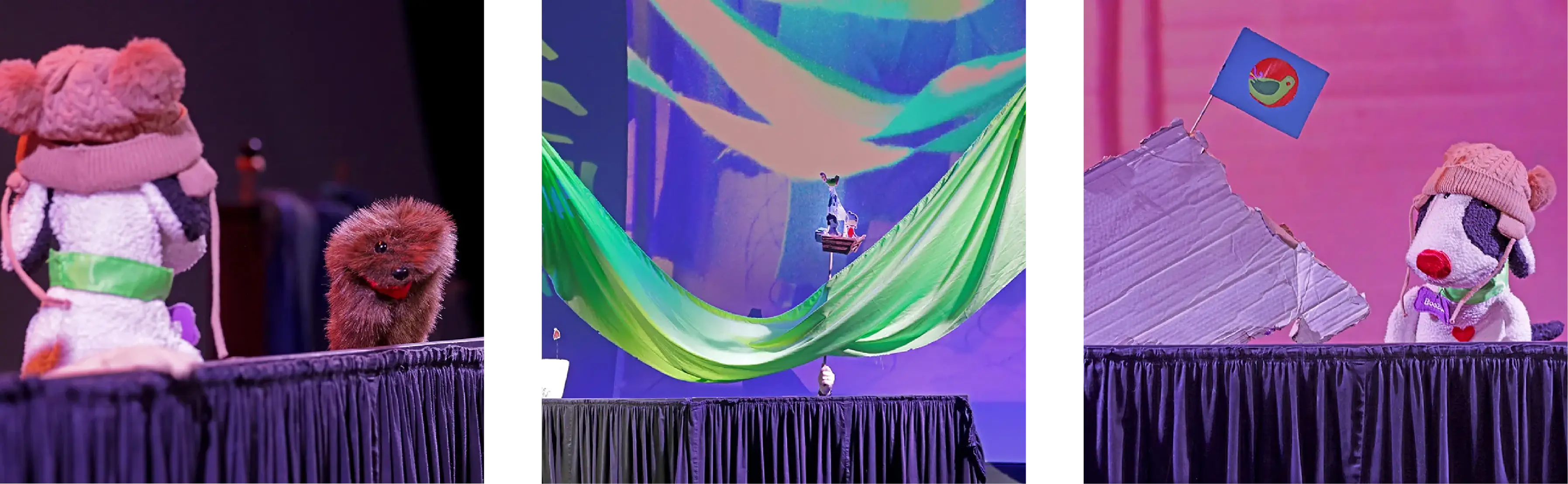
Lighting the Way, a story of friendship and bravery, brings together multiple puppetry styles and technologies. The main characters, our Stepping Stones Storytellers (BooZoo, Lucy, Bird, and Lillie the Ladybug), primarily appear as huggable hand and rod puppets. They perform above a puppet stage while the puppeteers navigate behind a curtain on rolling stools.
The world they inhabit is created through props and, most importantly, a cranky. A cranky, also called a paper movie or moving panorama, consists of a scroll housed in a frame. As rods rotate the scroll, imagery unfolds in sequence. In our production, the cranky sits beside the puppet stage. Its live performance is captured by a video camera and projected onto the theater screen. The result is a composite performance in which three dimensional hand puppets, a two dimensional paper landscape, and large scale projection merge into a unified environment.
The characters themselves also shift in form and scale. During a boat ride across the aurora borealis, or while climbing the summit of Mount Everest, they transform into two dimensional cardboard figures much smaller than their hand puppet counterparts. This shift emphasizes the epic scale of their journey.
All of this emerges through research, writing, inquiry, and experimental fabrication. The team reviews the script, shares ideas, and makes collective choices that support a unified narrative experience.
Many puppeteers wear every hat: designer, director, builder, performer, and more. At Stepping Stones, each team member takes on multiple roles, but it is our collaboration that makes the work possible. Puppet show making is not easy. Having a community of dedicated artists makes the challenges easier to navigate, especially when the process becomes difficult or a cardboard boat falls apart.
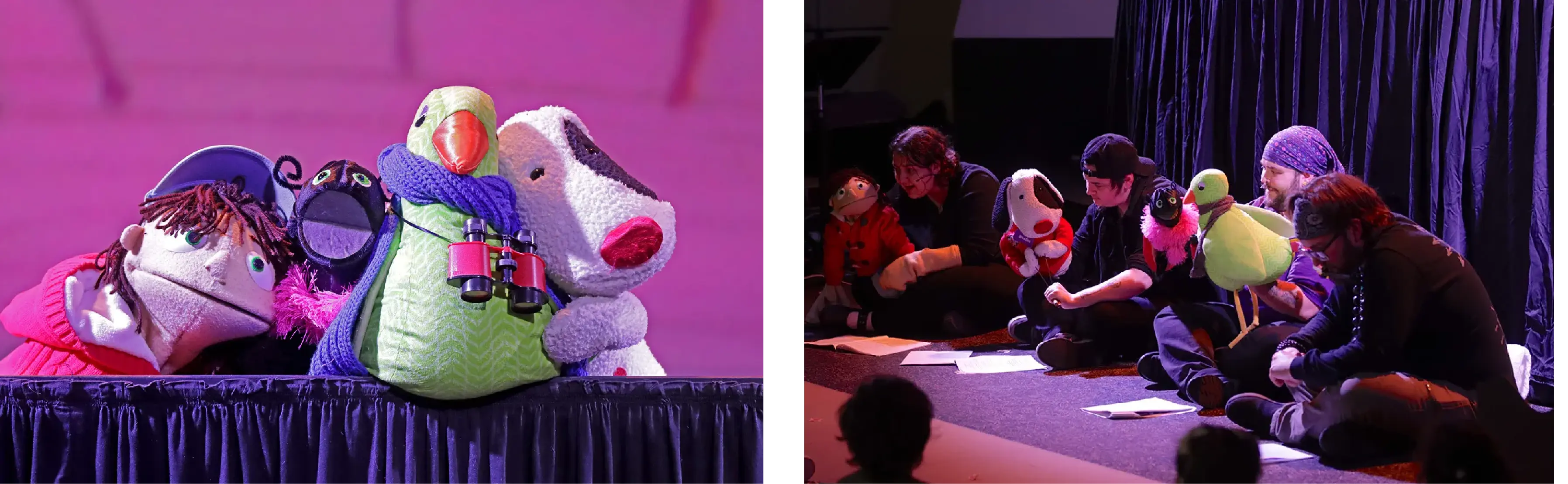
This spirit of collaboration is also at the heart of Lighting the Way. Throughout the story, the characters encounter setbacks. The lights go out during book club. Their engine fails in the Atlantic Ocean. A windstorm on the mountain blows away their much needed starshine nets. Each time, the characters rely on their unique strengths to overcome obstacles. Bird leads with expert navigation. Lillie sings to the aurora borealis for a ride across the sky. BooZoo uses his keen sense of smell to track lost tools. When all seems lost, Lucy rallies the group to keep reaching toward their goal. Each character contributes something essential, reflecting how each of us can draw upon our individual strengths to meet the moment.
During their climb, the Storytellers believe they are being pursued by a yeti. These moments introduce an exciting sense of safe peril while exploring the idea of not jumping to conclusions. The mysterious figure turns out not to be a monster at all, but Steve the Snowman, who is simply on vacation. He has been chasing them to return a lost hat and ultimately saves the day by lassoing the North Star to carry them home. This unexpected friendship reminds us that fear of the unknown can limit creativity, connection, and discovery.
Stories like this reflect the values we strive to embody through puppetry: collaboration, curiosity, and the courage to meet the unknown. What happens onstage often becomes a mirror not only for the audience, but also for the artists bringing the characters to life.
So what is my favorite puppet? The one that helps a story breathe. The one that allows an audience to see themselves, their fears, and their hopes reflected onstage. The one that reminds us of the power of creativity, collaboration, and curiosity.