





Upcoming Shows

Upcoming Events
"Creativity is the act of smashing two things together and seeing what happens. It goes back so far in our history, all the way to smashing pieces of flint together and seeing what happens."
~ Jacob Collier
When I am talking about the work of puppetry and all-around art making, I am often met with remarks about how the person I'm chatting with isn't creative or has no imagination. I have encountered this reaction for several years, and it is a heavy feeling to be met with someone's lack of appreciation for something so fundamental in our lives.
I usually respond by saying that it took their imagination and creativity to communicate that idea. When you think about that process, a series of relationships has occurred.
- Hearing an artist discuss their work.
- Processing the heard information and labeling it with the idea of "creative."
- Meeting the feeling of being "outside" of the other person's experience.
- Stringing together language of the mind to shape the internal feeling into something transferable.
- Vocalizing the language into an audible and understandable idea.
There is a lot going on there! Except, we do it every day, even if we are communicating to ourselves. This spontaneous creative act is so intertwined with our everyday life that it gets taken for granted. Or, on another note, cooking breakfast or even commuting requires focused energy to coordinate the mind and body into a helpful arrangement over time while incorporating the context of a given moment. Deeply creative acts, conceptually removed from the idea of creativity.
An underlying set of beliefs that has informed this thinking is a culture of commodification. Historically, we idealize and reward those who can make a buck off their abilities, ideas, products, etc. If it is not profitable, it is not valuable. If it is profitable, "Oh wow! That's a great idea! You're very creative!" When something is not valued, we lose sight of it and deem it unimportant. However, I don't know if there is a more creative act than a mother waking her children, making them breakfast, and driving them to school. Caregiving for children is deeply creative and one of, if not the most valuable contributions to society a person can make, and yet it is historically the most under appreciated.
And what is raising a child if not meeting the moment where it is and working with what you have?
These ideas arose as I listened to a master class by the musician Jacob Collier (who famously is "diagnosed" with creativity infinity syndrome). I am inclined to agree with the diagnosis, as another artist thoroughly exhilarated by his understanding of music, sound, and overall ability to meet a moment using the medium of music to generate incredible compositions and reactions from audiences. As well as being a fantastic musician, his ability to articulate the nature of creativity and music is inspiring. As he discusses music, I found myself recognizing the creative process and nature of music in complete parallel with the puppetry process.
Puppetry requires several conditions to occur.
- An object.
- Space for the puppet to inhabit and move in.
- Light to illuminate the figure or create its silhouette.
- An operator (the puppeteer).
- An observer (at minimum, the puppeteer may also act as the observer).
This set of conditions speaks specifically to the act of performance, when an inanimate object is brought to life. And each of these conditions comes with near-infinite layers of variables that range from the way a puppet is painted to whether the puppeteer has a stiff back. In each case that puppetry occurs, the puppeteer juggles all of these variables, and if they are "successful," the illusion of life (or "puppetry") actually occurs.
It is simultaneously a high-wire act while also being a completely natural process that has evolved from our ability to perceive and communicate with one another. And the scale at which one may experiment with the conditions of puppetry is as vast as the ocean.
Someone may pick up a napkin and a straw for a tango on the dinner table, or stage a multimedia production of Shakespeare that needs 50 performers, an orchestra, and carbon fiber animatronic puppets. In either case, they are no different from one another on a fundamental level:
Meeting the moment, exploring how things work together, and sharing what happens.
It is so fundamental that there really isn't anything that we do that does not fall within this method. However, what we can work on is a quality of openness and perception that allows us to see how robust the possibilities of working with the world around us really are. What I think surprises people about an artist, that makes people think it is outside of their scope, is how an artist makes surprising connections within a given situation or medium.
Discerning potentialities and taking the leap to connect the dots between what arises within a given context is a skill that can be cultivated.
I have found that exploring the art of puppetry is a rich sphere to explore, experiment, and expand our understanding of the rich tapestry of creative potential the world around us offers.
It helps that one of the realities of puppetry is this simple fact: anything can be a puppet.
You don't need to figure out how to stitch together a muppet. You could start with a sock, a spoon, or a piece of paper.
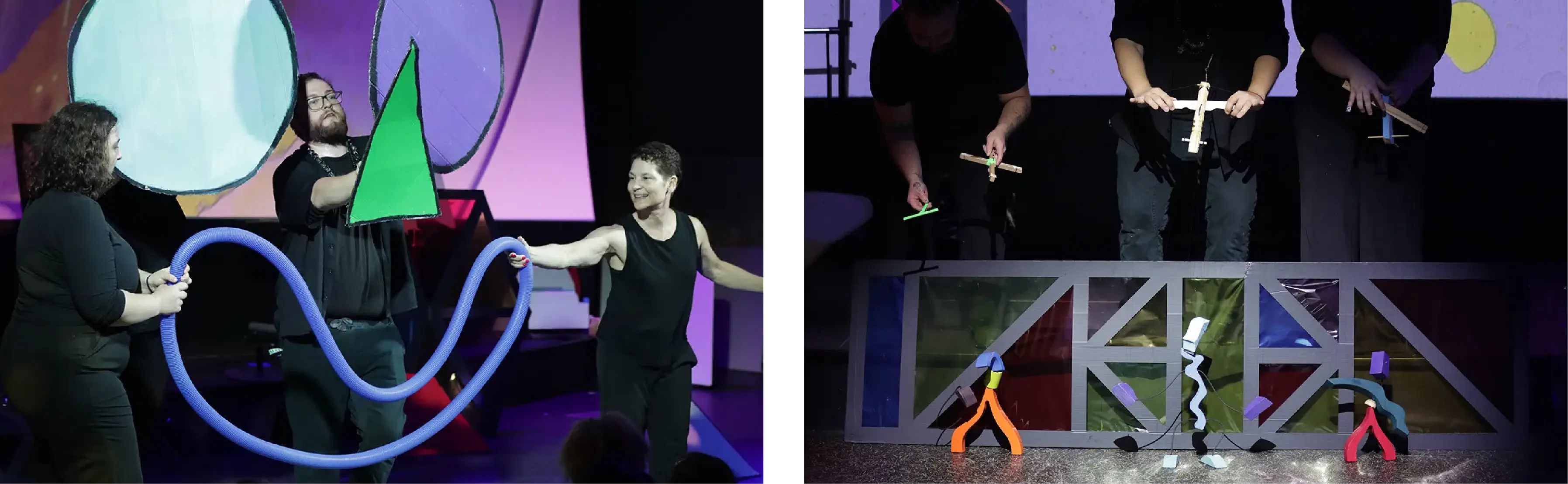
Whatever it is, notice how you can move it, its colors, textures, how it reacts to light, or how it stands out in different spaces. Give it a shot seeing how you can make it breathe. Twist, pull, crush, or glue something to it. Not only can anything be a puppet, a puppet can be anything. From a grasshopper, to your grandma, or a sneeze.
Puppetry, like any other art, is a process of discovery. Making those connections following a sense of what feels right, sparks a feeling, or gets a laugh. Take your time. You might find you've made a puppet that has a lot to say, or one that only speaks through movement. Both are perfectly valid experiences, but I do encourage you to deeply consider how the puppet can get ideas across through how it moves. The more I've learned about puppetry, performed, and watched other artists from around the world, the more I've come to learn that the most effective puppets need not say a word at all.
Be mindful of sticky ideas. Sticky ideas are those labels that come up and we latch onto them. These can be quite helpful and sometimes just that one idea can snowball into something truly exciting. However, it is these sticky ideas that can also blind us to other possibilities. I think a good idea is one with branches, rather than one that shuts down other options. You might decide that your puppet is really good at being sad and think, "This puppet can only be sad." However, you can play with how good a puppet is at being sad and stun the audience when it learns how to be happy. A good idea twists, turns, and can be flipped upside down. This is where the best stories come from, when we expect one thing and get the rug pulled out from under us.
So, whether you are making breakfast or your 101st puppet show, I hope you come away reading this with an appreciation for your inherent creativity. It is abundant, and no one can take it from you.
A great teacher once said:
"A great deal of chaos occurs in this world because people do not fully appreciate themselves."
~ Chogyam Trungpa
Peace, Love, and Puppets, TJ